Care Home Infection Prevention and Control Manual (CH IPCM)
When a care home uses products or adopts practices that differ from those stated in this Care Home Infection Prevention and Control (CHIPC) Manual, that Care Home is responsible for ensuring safe systems of work including the completion of risk assessments approved through local governance procedures and documented.
The CHIPC Manual and supporting resources can be accessed via mobile devices including phones, tablets, computers and laptops. Referring to the online version of the manual is strongly advised as content is updated in real time. If any content of the CHIPC Manual or resource section is printed off, locally documented version control governance arrangements must be in place to ensure that IPC practice is evidence based and current.
 View latest news and updates for the NIPCM and CHIPCM
Last updated: 3 August 2026
What is the Care Home Infection Prevention and Control Manual (CH IPCM)?
The Care Home Infection Prevention and Control (CHIPC) Manual, referred to as ‘the manual’ throughout, was first published in 2021. It is evidence-based and is intended to be used by all those involved in care home provision in Scotland.
The manual is care home context specific and has been co-produced with national and local IPC stakeholders. The content of the manual is aligned to the same scientific literature and evidence base as the National Infection Prevention and Control Manual (NIPCM) which was first published in 2012, by the Chief Nursing Officer (CNO (2012)1).
The manual currently contains
- Chapter 1 – Standard Infection Control Precautions (SICPs)
- Chapter 2 – Transmission Based Precautions (TBPs)
The manual is a practice guide which should be locally adopted for use in care homes. When implemented, the manual can help reduce infection risks and ensure the safety of residents and others in the care home environment. It is the Scottish Government expectation that care home settings locally adopt and implement this guidance.
The manual aims to:
- make it easy for staff to deliver evidence based infection prevention and control (IPC) precautions
- help reduce the risk of infections in care homes
- reduce variation, promote standardisation, and optimise IPC practices throughout all care home settings
- support staff knowledge and application of evidence based IPC
- help align practice, monitoring, quality improvement and scrutiny
Additional care home IPC support materials
There are links throughout the manual for additional supporting resources. The resources page provides useful links to a variety of IPC campaign materials, educational resources, toolkits and posters.
In addition you may wish to explore the various literature reviews which details the evidence base underpinning national IPC guidance.
Educational resources are also available via the IPC learning zone on TURAS.
A glossary section has been provided to expand upon the terminology used throughout national IPC guidance and support resources.
Responsibilities for the CH IPCM
Responsibilities for content of the manual
ARHAI Scotland to ensure:
- that the content of this manual remains evidence based or where evidence is lacking, content is based on consensus of expert opinion
Stakeholders of ARHAI Scotland programme working groups to ensure:
- full participation in the working groups including full engagement with the consultation process outlined in the Terms of Reference associated with each working group
Responsibilities for the adoption and implementation of this manual
The manual should be used by:
- care home organisations
- care home staff including permanent, agency and where required external contractors
- health protection teams
- infection prevention and control teams
- professionals providing support
- individuals visiting the care home
Care home providers to ensure:
- adoption and implementation of this manual in accordance with existing local governance processes
- local systems and resources are in place to facilitate implementation and compliance monitoring of IPC as specified in this manual
- compliance monitoring includes all staff (permanent, agency and where required external contractors)
- there is an organisational culture which promotes incident reporting and focuses on improving systemic failures that encourage safe IPC working practices including near misses
- there is a nominated local lead with responsibility for IPC
- implementation of the hierarchy of controls (appendix 16)
- that risk assessments are undertaken and documented for any deviations from the manual. Risk assessments must include information regarding local mitigation measures which have been approved by appropriate personnel and the local governance processes for the continual monitoring of any deviations and mitigations
- that application of risk management systems and risk assessment in the workplace to control occupational hazards are in place
Care home managers to ensure that all staff:
- are aware of and have access to this manual
- have completed IPC induction, education and training which is appropriate to their roles and that training and education records are centrally recorded for inspection, assurance and monitoring purposes. Training may include resources developed by your organisation, your local NHS board, Health and Social Care Partnership, NHS Education for Scotland (NES) or the Scottish Social Services Council (SSSC)
- have adequate support and resources available to enable them to implement, monitor and take corrective action to ensure full compliance with this manual
- with health concerns (including pregnancy) or those who have had an occupational exposure to any infectious agents are timeously referred to the relevant agency, for example general practitioner (GP or doctor), occupational health or if required accident and emergency
- have undergone the required occupational immunisations, health checks or clearance
- include IPC as an objective in their personal development plans (or equivalent)
Individuals providing care must ensure that:
- they understand, adopt and implement the principles of IPC as set out in this manual
- maintain IPC competence, skills, and knowledge through completion of appropriate training including NHS Education for Scotland (NES) and Scottish Social Services Council (SSSC)
- communicate the IPC practices to be taken to colleagues, residents, relatives and visitors without breaching confidentiality
- have up to date occupational immunisations, health checks and clearance requirements as appropriate
- report to line managers any gaps in IPC knowledge, resources, equipment and facilities or incidents that may result in the potential transmission of infectious agents including near misses, for example incidents involving sharps, an interruption to the water supply or PPE failings
- should not attend work if they would be providing care whilst at risk of potentially transmitting infectious agents to residents or others
- are aware they should contact their line manager, the person in charge, and (if necessary) the occupational health service, the local IPC team or Health Protection Team to obtain advice regarding infectious illnesses
- are aware they should contact the local NHS Board IPCT/HPT if there is a suspected or actual outbreak of infection within the care home
Local infection prevention and control teams (IPCTs) and health protection teams (HPTs) to:
- engage with staff to develop systems and processes that lead to sustainable and reliable improvements in relation to the application of IPC practice within the care home
- provide expert advice on the application of IPC and support to develop individual or organisational risk assessments where deviations from the manual are deemed necessary
- provide local support and advice (when necessary and/or requested) when an incident or outbreak is suspected
Please note. formal notification of any incidents and outbreaks for the care home sector is undertaken by the local HPT.
Chain of infection
In order for infection to occur several things have to happen. This is often referred to as the chain of infection. The six links in the chain are:
- infectious agent or the microorganism which can cause disease
- reservoir or source of infection where the microorganism can live and thrive. This may be a person, an animal, any object in the general environment, food or water
- portal of exit from the reservoir. This describes the way the microorganism leaves the reservoir. For example, in the case of a person with flu, this would include coughing and sneezing. In the case of someone with gastroenteritis microorganisms would be transmitted in the faeces or vomit
- mode of transmission. This describes how microorganisms are transmitted from one person or place to another. This could be via someone’s hands, on an object, through the air or bodily fluid contact
- portal of entry. This is how the infection enters another individual. This could be landing on a mucous membrane, being breathed in, entering via a wound, or a tube such as a catheter.
- susceptible host. This describes the person who is vulnerable to infection.
Infection can be prevented by breaking the chain of infection.
Chain of infection diagram
The overall aim of Standard Infection Control Precautions (SICPs), is to break the chain of infection.
The chain of infection diagram illustrates and gives examples of actions that can be taken to break it.
Select image for full size version.
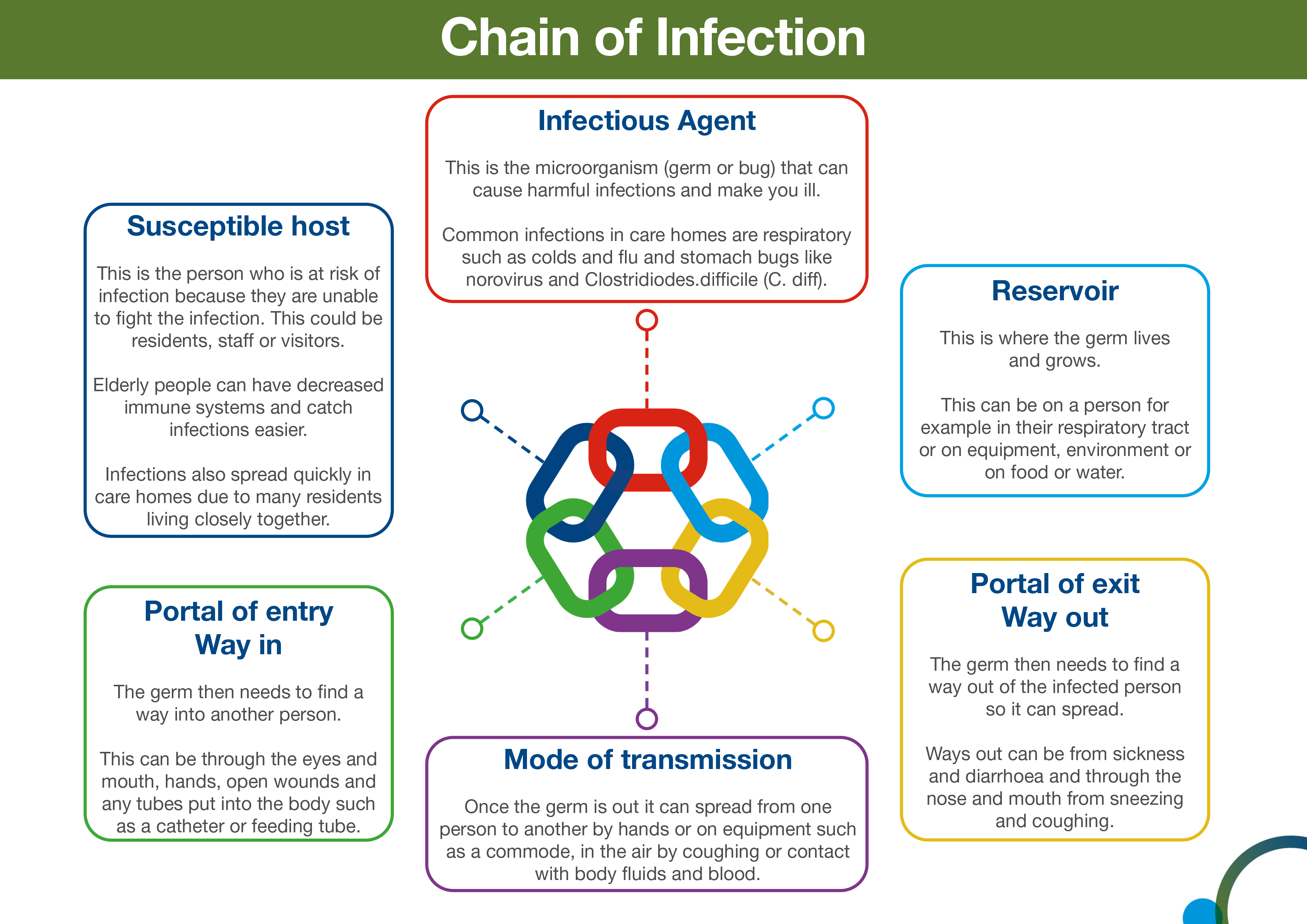
 Use the NES SIPCEP Breaking the Chain of Infection module to learn about breaking the chain of infection in care homes.
Chapter 1: Standard Infection Control Precautions (SICPs)
To provide a safer environment for residents, staff and visitors the basic IPC measures that should be applied in all care homes are called Standard Infection Control Precautions (SICPs).
Standard Infection Control Precautions (SICPs). SICPs are applicable for all staff, in all care settings, at all times, and for all residents - regardless of whether any infections are known to be present or not.
SICPs are necessary and should be applied continually and consistently to reduce the risk of transmission of infectious agents from both known and unknown sources of infection throughout the care home.
Sources of (potential) infection may include
- blood
- body fluids
- secretions or excretions (excluding sweat)
- non-intact skin
- mucous membranes
- the care environment (fixtures, fittings, floors, walls) or any care equipment, furniture or furnishings which may have become contaminated, are inadequately cleaned or maintained, or are damaged and can no longer be adequately cleaned or maintained
The application of all 10 SICPs allows staff to ensure effective IPC occurs at the point of care delivery and is determined by an assessment of risk, for:
- any anticipated exposure to blood or body fluids
- and the level of interaction when the following 3 elements come together, the service user (resident), the healthcare worker and, the health and care environment
SICPs implementation monitoring will be regularly undertaken within each workplace to assure safe IPC practices are embedded, and to demonstrate the organisations commitment to IPC, and the safety of all residents, healthcare workers and visitors to each facility.
1. Resident placement: assessment for infection risk
Throughout their stay, and prior to admission, arrival or transfer into a care home, each resident should be assessed for any historical, known or suspected infection risks which may require
- the application of Transmission Based Precautions (TBPs) as described within Chapter 2
- the development of a risk assessment that considers the residents health and wellbeing, capacity to make decisions, and understand the measures or actions required to prevent or minimise cross infection within the care home.
The indications for cross-infection risks, and the requirement to apply TBPs are described in Chapter 2.
Resources
Appendix 11 of the NIPCM provides further information on the precautions required for different infectious agents.
The A to Z of pathogens provides information regarding descriptions of infectious agents, the usual incubation periods and infectivity.
Further information regarding respiratory symptoms screening questions can be found within the resources section of the NIPCM.
 Read the patient and resident placement literature review to understand the evidence base for assessment of infection risks and resident placement decisions.
2. Hand hygiene
Please note that the term ‘alcohol-based hand rub (ABHR)’ has now been updated to ‘hand rub’. A hand rub (alcohol or non-alcohol based) can be used if it meets the required standards. Please see further information in the hand hygiene products literature review.
Hand hygiene is considered an important practice in reducing the transmission of infectious agents which cause infections.
Adherence with the following points is essential to ensure effective hand hygiene:
- expose forearms (be bare below the elbows)
- remove all hand/wrist jewellery including any embedded jewellery (a single, plain metal finger ring or ring dosimeter (radiation ring) is permitted but should be removed (or manipulated) during hand hygiene). Bracelets or bangles such as the Kara which are worn for religious reasons should be able to be pushed higher up the arm and secured in place to enable effective hand hygiene which includes the wrists
- ensure fingernails are kept clean, short and that no artificial nails or nail products are being worn
- cover all cuts or abrasions with a waterproof dressing
Hand washing should be extended to forearms if there has been exposure of forearms to blood and/or body fluids.
Hand washing sinks should only be used for undertaking washing and should not be used as a disposal route for any other liquids. (think-sink-think-splash-think-safety)
To perform hand hygiene: hand rubbing
- hand rubs should be readily available for staff as near to point of care delivery as possible. Where this is not practical, personal hand rub dispensers should be used
- apply a sufficient volume of hand rub to cover all surfaces of the hands to ensure effective hand hygiene
- hand rub manufacturer’s instructions should be followed for the volume of hand rub recommended to provide adequate coverage for the hands. In the absence of manufacturer’s instructions, volumes of approximately 3ml are recommended to ensure full coverage
- hand rub dispensers (cartridges/bottles) should not be refilled and should be replaced when empty or if has exceeded the shelf life or expiry date that has been recommended by the manufacturer
The World Health Organization’s ‘4 moments for hand hygiene’ should be used to highlight the key indications for hand hygiene within the care home.
Some additional examples of hand hygiene moments include, but are not limited to:
- after touching a resident’s immediate surroundings
- before handling medication
- before preparing food
- before donning (putting on) and after doffing (taking off) PPE
- after visiting the toilet
- between carrying out different care activities on the same resident
- after cleaning and disinfection procedures
- after handling used linen
- after handling waste (including used PPE)
It is important that residents are encouraged and supported to perform hand hygiene particularly after using the toilet and before consuming food and drink.
To perform hand hygiene: Hand Washing
Hands should be washed with antimicrobial liquid soap and water if/when:
- they are visibly soiled or dirty
- they are potentially contaminated with blood, other body fluids or excretions
- caring for a resident with vomiting or diarrhoeal illness
- caring for a resident with a suspected or known gastro-intestinal infection such as norovirus or a spore forming organism such as Clostridioides difficile
Note:
Hands should be washed with warm/tepid water to mitigate the risk of dermatitis associated with repeated exposures to hot water and to maximise hand washing compliance. Compliance may be compromised where water is too hot or too cold.
Hands should be dried thoroughly following hand washing using a soft, absorbent, disposable paper towel from a dispenser which is located close to the sink but beyond the risk of splash contamination.
The use of antimicrobial hand wipes is only permitted where there is no access to running water. Staff should perform hand hygiene using hand rub immediately after using the hand wipes and perform hand hygiene with soap and water at the first available opportunity.
In all other circumstances use hand rub for routine hand hygiene.
Skin care
- Hand rubs should contain emollients in their formulation.
- Pat hands dry after hand washing using disposable paper towels. Avoid rubbing which may lead to skin irritation/damage.
- Use an emollient hand cream during breaks and when off duty. These should be applied all over the hands including between the fingers and the back of the hands.
- Staff with skin problems should seek advice from the local occupational health department if available or their GP.
- Barrier creams should not be used in the workplace.
Do not use refillable containers or communal tubs of hand cream in the care home setting.
Resources

Read the hand hygiene literature reviews to find out more about the evidence base for hand hygiene.
 To make sure you clean your hands properly you should follow the steps in the poster ‘How to hand rub step by step images’ and ‘How to hand wash step by step images’. This poster can be printed off and displayed throughout the care home to ensure that all staff and visitors are aware of and practice this hand hygiene method when required in the care home.
3. Respiratory and cough hygiene
Infectious agents from the respiratory tract can spread by coughing and sneezing, therefore it is very important that respiratory and cough hygiene is being undertaken by staff, residents and visitors to minimise any risk of cross-infection.
Any resident displaying symptoms of respiratory illness should be encouraged to wear a fluid resistant surgical face mask (FRSM) whilst outside their room, or when an individual enters their room, if it is clinically safe and can be tolerated by the resident.
What is required for respiratory and cough hygiene is:• access to disposable tissues• a waste bin or waste bag in easy reach• hand hygiene products
An individual who has a cough, cold or other respiratory symptoms should be advised and encouraged to:
- turn their head away from others when coughing or sneezing
- cover their nose and mouth with a disposable tissue when sneezing, coughing, wiping and/or blowing the nose
- all used tissues and face masks should be placed into a waste bin immediately after use
- wash hands with antimicrobial liquid soap and water after coughing, sneezing, using tissues, or after contact with respiratory secretions or objects contaminated by these secretions
- keep contaminated hands away from the eyes nose and mouth
Staff should:
- promote respiratory and cough hygiene and help residents who need assistance
- ensure that residents are provided with access to tissues, waste bag and hand hygiene products and make sure that products are in reach
- use hand wipes followed by hand rub if there is no running water available or if hand hygiene facilities are out of reach then wash hands at the first available opportunity.
Read the respiratory and cough hygiene literature review to find out the evidence for respiratory and cough hygiene practice.
4. Personal Protective Equipment (PPE)
Deciding which PPE to use
Before doing any procedure or task staff should risk assess any likely exposure to blood and/or body fluids and ensure PPE is worn that provides adequate protection against the risks associated with the procedure or task being undertaken.
All PPE should be:
- located close to the point of use
- stored in a clean and dry area to prevent contamination until needed for use
- within expiry dates
- single-use only items unless specified as reusable by the manufacturer
- checked for any damage or defects before donning
- changed immediately after individual use and/or following completion of a procedure or task
- disposed of after use into the correct waste stream
Reusable PPE items, for example non-disposable goggles, face shields or visors must be cleaned/decontaminated once removed or placed within a designated container for subsequent cleaning/decontamination with decontamination schedules in place and responsibility assigned.
Gowns, headwear and footwear are unlikely to be required as part of the PPE ensemble within a care home setting. Please refer to the NIPCM for further guidance on use if required.
Disposable items of PPE you might require at the point of care delivery. • gloves• aprons• gown• fluid resistant surgical masks (FRSM)• eye/face protection
Donning (putting on) personal protective equipment (PPE)
The order for putting on PPE is:
- apron or gown
- fluid resistant surgical mask (FRSM)
- eye/face protection (where required)
- gloves
Doffing (taking off) personal protective equipment (PPE)
It is important that PPE is removed in the correct order.
The order for taking off PPE is:
- gloves
- apron or gown
- eye/face protection (if worn)
- fluid resistant surgical mask (FRSM)
Note:
Always carry out hand hygiene immediately after taking off PPE.
If using eye and face protection an extra hand hygiene step should be carried out after removing the apron or gown and before removing eye and face protection.
Once all PPE is removed it should be disposed of as healthcare waste and hand hygiene should be performed.
Resources
 A poster showing the donning (putting on) and doffing (removing) of PPE is available to print.
Gloves
Gloves should be:
- worn when it is likely or anticipated that you will be exposed to blood, body fluids (including but not limited to secretions and/or excretions), non-intact skin, mucous membranes, lesions and/or vesicles, hazardous drugs, and chemicals for example cleaning agents
- single-use and should be donned (put on) immediately prior to exposure risk and should be doffed (taken off) immediately after each use or upon completion of a task
- appropriate for use, fit for purpose and well-fitting. The glove selection chart can help you select the correct gloves
- changed if damaged or a perforation or puncture is suspected
Note:
Using gloves reduces the risk of contamination but does not remove all risk.
Gloves should not be used instead of carrying out hand hygiene.
Gloves should not be worn inappropriately in situations such as to go between residents, move around a care area or whilst at workstations (on the telephone or computer).
Gloves are single use disposable items and should never be decontaminated or cleaned with hand rub or by washing with cleaning products.
Use the glove selection chart to support you to select the correct glove type.
Aprons and gowns
Selection of aprons or gowns for use in health and care settings should be based on an assessment of the task to be undertaken, and the anticipated levels of blood or body fluid exposure.
Aprons should be:
- disposable
- fluid repellent
- used to protect the uniform, workwear or clothes to prevent exposure or contact with another person’s:
- blood or body fluids (including urine, faeces, vomit, nasal discharge, wounds, sores)
- mucous membranes (including nose and mouth)
- rashes (for example confirmed or suspected scabies)
- leaking vesicles (for example confirmed or suspected shingles)
- used to protect uniform, workwear or clothes when exposure or contact with hazardous drugs, chemical or cleaning products is likely
- used to protect uniform, workwear or clothes when contact or exposure or handling of used, soiled, or infectious linen/laundry is likely
- to protect uniform, workwear or clothes when providing direct care to a resident during assisted toileting, or eating
- regarded as single use items which should never be reused (one resident, one task, one apron)
Eye/face protection
Eye/face protection should:
- be worn when there is an anticipated risk of splashing or spraying of blood or bodily fluids
Note:
Eye/face protection should not be touched when worn or worn around the neck or on top of the head when not in use.
Eye/face protection should be compatible with other items of PPE and worn in accordance with manufacturer’s instructions.
Prescription eyeglasses and contact lenses should not be considered a form of eye/face protection.
Fluid resistant surgical face masks (FRSM)
Fluid resistant surgical face masks should be:
- worn if splashing or spraying of blood or body fluids onto the nose and mouth is anticipated/likely
- well-fitting with an integral nose clip or wire and an easily identifiable inner and outer surface
Fluid resistant surgical face masks should be removed or changed:
- between resident contact
- at the end of a procedure/task
- if the integrity of the mask is compromised because it is damaged, damp, wet, soiled or visibly contaminated with blood or body fluids
Transparent face masks
Transparent face masks may be used
- when there are communication barriers, if they meet the specifications of BS EN 14683:2025
Resources
Read the surgical face masks literature review for further information regarding the evidence base.

See appendix 11 for FRSM use during the application of Transmission Based Precautions (TBPs)
SICPs PPE Summary Table
| Gloves | Aprons | Gowns | Eye/Face protection | Fluid Resistant Surgical Masks (FRSM) | Respiratory Protective Equipment (RPE) |
|---|---|---|---|---|---|
| When it is anticipated that there is contact with or exposure to blood, bodily fluids, secretions, excretions, non-intact skin or mucous membranes or contaminated surfaces. Use gloves in accordance with Appendix 5 – Glove use and selection. |
When in direct care contact with a resident or their immediate environment. | When there is a risk of extensive splashing of blood and/or other body fluids. Worn when a disposable apron provides inadequate cover for the procedure or task being performed. |
When there is an anticipated risk of splashing and/or spraying of blood or bodily fluids. | When splashing or spraying of blood, body fluids, secretions, or excretions onto the respiratory mucosa (nose and mouth) is anticipated/likely. | Not required. |
PPE for visitors
Visitors are not routinely required to wear PPE unless they are providing direct care to the resident they are visiting.
If the need for PPE is identified, staff should provide advice on its correct use.
If, following an explanation of potential risks, a visitor declines to wear PPE when offered, then this should be respected, and the visit must not be refused. There is no expectation for staff to monitor the use of PPE by visitors. The table below shows the PPE which should be worn where appropriate and when the visitor chooses to do so.
PPE use for care home visitors
| Gloves | Aprons | Fluid Resistant Surgical Masks (FRSM) | Goggles, visors, face shields for eye/face protection |
|---|---|---|---|
| If providing direct care which exposes them to blood and/or body fluids for example assisted toileting or feeding. | To protect clothing if they intend to provide direct care which will expose them to blood/ or body fluids, or there is likely to be splashing of blood or bodily fluids during care delivery. | To protect their nose and mouth from likely splash/spray of blood or body fluids. | To protect their face and eyes from any likely splash or spray from blood or body fluids. |
Read the PPE literature reviews to find out more information about the evidence base for PPE use.
5. Safe management of non-invasive, reusable, shared care equipment
Care equipment can be easily contaminated with blood, body fluids, secretions, excretions, and infectious agents, making it a possible source for transmission of infectious agents during care delivery.
Important words and what they meanRoutine cleaning The regular, planned, systematic cleaning regime by use of the appropriate decontamination agents such as detergents, disinfectants or combination products.Cleaning The removal of any dirt or body fluids (such as blood, vomit) by use of the appropriate decontamination agents such as detergents, disinfectants or combination products (commonly referred to as routine cleaning).Decontamination The process of removal, destruction, or inactivation of microorganisms, from an item or surface to make it safe for handling, reuse, or disposal, through a combination of cleaning and disinfection.Disinfectant A chemical used to reduce the number of infectious agents from an object or surface to a level that means they are not harmful to health. Detergent A chemical cleansing agent that can dissolve oils and remove dirt. Detergent, general purpose detergent and neutral detergent terms may be used interchangeably.
If the resident has a known infection or the equipment is contaminated with blood or body fluids, then a disinfectant product should be used.
Disinfectant products should be selected based on compatibility with the equipment being decontaminated, as stated in manufacturer’s instructions.
Note:
Do not use household bleach as the required dilution cannot be guaranteed.
Do not refill bottles for cleaning products as there is a risk of contamination.
What you will need for safe management of non-invasive, reusable, shared care equipment.
- Cleaning/disinfectant products:
- general purpose detergent and water solution/detergent impregnated wipes
or
-
- a combined detergent-disinfectant solution prepared and used according to manufacturer’s instructions.
or
-
-
a detergent followed by a disinfectant solution prepared and used according to manufacturer’s instructions.
-
- Paper towels/disposable cloths.
Types of equipment
There are three different types of care equipment that you will use in your care home and it is important that you know how to deal with each type.
You should follow manufacturers guidance for all equipment and products you use including those used for cleaning and decontamination.
Before using any sterile equipment, you should check that:
- the packaging is intact
- there are no obvious signs of packaging contamination
- the expiry date remains valid
1. Single-use - equipment which is used once on a single resident and then discarded.
Single-use equipment must never be reused even on the same resident. The packaging carries the symbol.

Note:
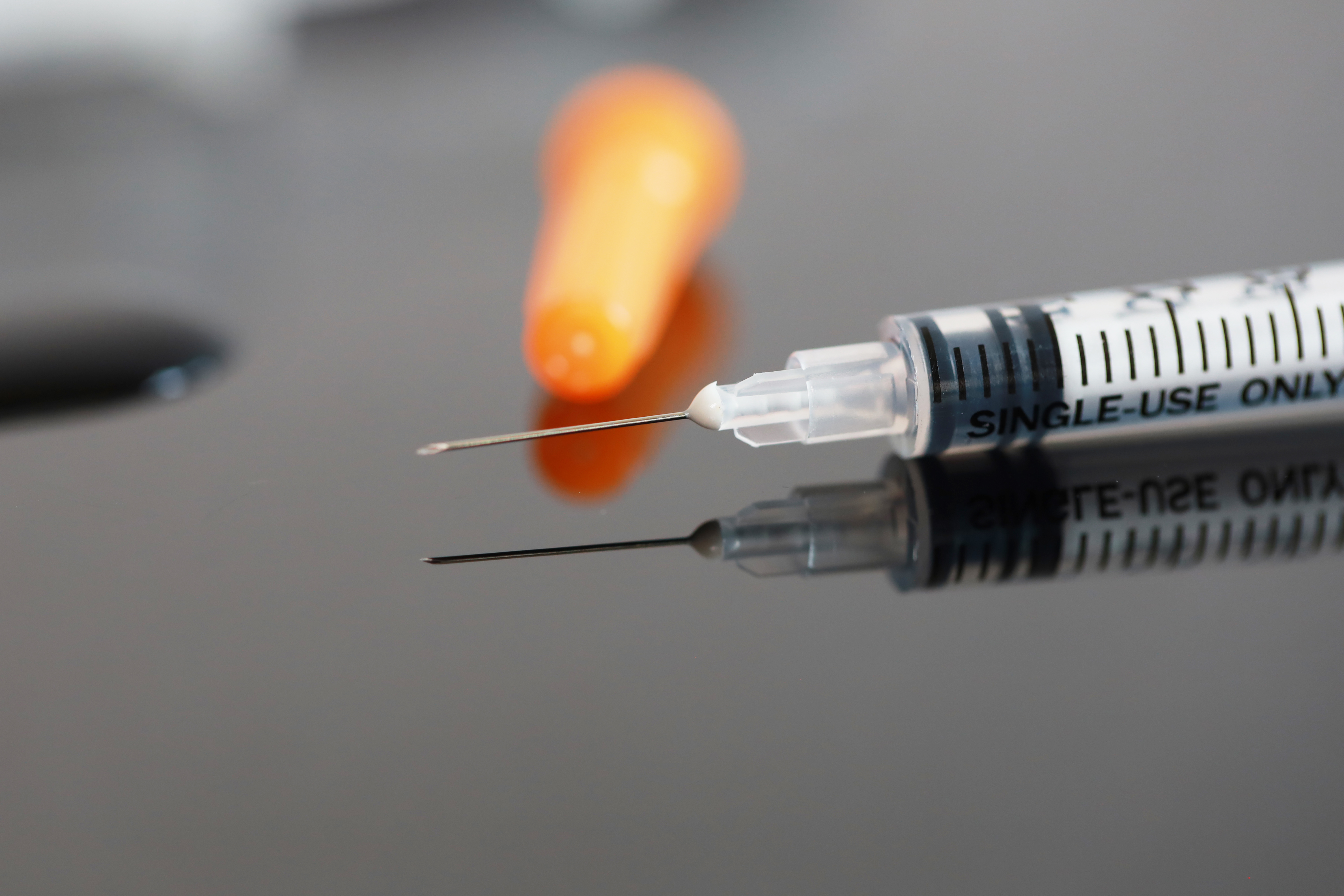 Needles and syringes are single-use devices. They should never be used for more than one resident or reused to draw up additional medication.
Never give medications from a single-dose vial or intravenous (IV) bag to multiple residents.
2. Single individual use – equipment which can be reused by same resident for example a sling and decontaminated following use as per manufacturers instructions.
3. Non-invasive, reusable, shared care equipment – equipment which can be reused on more than one resident following decontamination between each use. For example commode, moving and handling equipment or bath hoist.
Cleaning or decontamination of non-invasive, reusable, shared care equipment
Residents should be given their own non-invasive, reusable equipment where possible.
Reusable equipment should be checked frequently for cleanliness and signs of integrity. This will include mattresses and pillows which should be clean, have a waterproof covering which is in a good state of repair.
Pillows used on resident’s beds may not require a waterproof cover if they are single resident use and are subject to regular checks/laundering. Resident pillows may require labelling where appropriate.
Reusable equipment should be cleaned or decontaminated:
- between individual use
- after blood and/or body fluid contamination
- as part of the regular scheduled cleaning schedules or process
- before inspection, servicing or repair
Staff should:
- follow the local cleaning protocol or schedule which should include responsibility for, frequency of and method of decontamination required
- use a general purpose detergent and water solution or detergent impregnated wipes
or
a combined detergent-disinfectant solution prepared and used according to manufacturer’s instructions.
or
a detergent followed by a disinfectant solution prepared and used according to manufacturer’s instructions
Non-invasive, reusable, shared care equipment should be cleaned or decontaminated:
- As soon as practicable after use
- Between use on different individuals
- when visibly soiled
- after blood or body fluid contamination
- following the resolution of an outbreak
- before and after inspection, servicing or repair
- before being loaned out and following return
- before decommissioning, recycling and disposal
- at regular, pre-defined intervals as part of an equipment cleaning schedule.
Cleaning and disinfectant solutions should be prepared and used according to manufacturer’s instructions taking into account the following:
- chemical concentration
- application style
- specific product contact time
- appropriate rinsing and drying
Disinfectant products should be selected based on compatibility with the equipment being decontaminated, as stated in manufacturer’s instructions.
Note: When an organisation use products or adopts practices that differ from those stated in this manual, that individual organisation is responsible for ensuring safe systems of work including the completion of risk assessments approved through local governance procedures.
Resources
Read the Safe management of non-invasive, reusable, shared care equipment literature review to find out more about why we do things this way for care equipment.
 The decontamination of non-invasive care equipment poster can help staff decide how to clean equipment.
6 - Safe management of the care environment
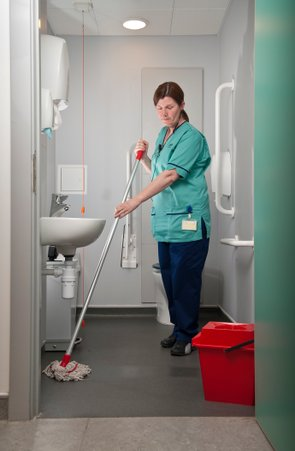 There are many areas in care homes that become easily contaminated with microorganisms (germs) for example door handles, toilets, waste bins, surfaces.
Furniture and floorings in a poor state of repair can have microorganisms (germs) in hidden cracks or crevices.
To reduce the spread of infection, the environment should be kept clean and dry and where possible clear from clutter and equipment.
Non-essential items should be stored and displayed in such a way as to aid effective cleaning
Keeping a high standard of environmental cleanliness is important in the care home as the residents are often elderly and vulnerable to infections.
The care home environment should be:
- visibly clean, free from non-essential items and equipment to help make cleaning effective
- well maintained and in a good state of repair
- routinely cleaned in accordance with the specified cleaning schedules:
- a fresh solution of detergent in warm water is recommended for routine cleaning. Solutions should be changed as per the manufacturer’s instructions
- routine disinfection of the environment is not recommended. However, disinfectants should be used to decontaminate sanitary fittings
Staff should:
- report any issues with the environment cleanliness or maintenance to the person in charge to ensure that the care environment is safe. The person in charge should then act on problems reported to them
- be aware of the environmental cleaning schedules and clear on their specific responsibilities
Cleaning schedules should include:
- staff responsibilities
- cleaning frequencies
- cleaning methods
Managing cleaning services
Cleaning services should be managed in a systematic way, and staff responsible for cleaning should be appropriately trained to carry out the tasks they are responsible for.
The care home manager is responsible for managing the cleaning service which has a number of essential elements outlined in the cleaning services diagram.
Select the Care Homes Cleaning Specification for full size version of cleaning services diagram.
Select the diagram for full size version
Cleaning Services
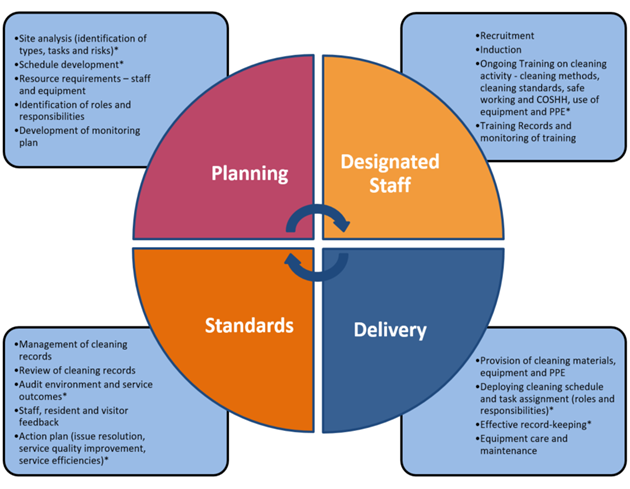
An effective service will include all of the elements above.
Care Homes Cleaning Specification
The Care Homes Cleaning Specification provides a guide to planning cleaning services. It has tools to help with the planning and recording of cleaning activities and with the management activities marked with a * in the diagram above. These include:
- a structure to identify all spaces within a care home and plan appropriate cleaning tasks and frequencies
- a set of weekly and monthly cleaning templates to be assigned to each space within a care home. These can be used to develop a schedule and to provide a method for recording all cleaning activity
The tools within the Cleaning Specification should be used by the care home manager in the planning, training of staff, delivery, and checking of standards of the cleaning services they provide.
Manufacturer’s instructions and recommended contact times should be adhered to.
Cleaning schedule and record
Table 2 provides an example of a cleaning schedule and record. These tools are examples and designed to support local practice, however care homes can use their own tools if preferred. If a local tool is used, it should reflect the standards set out in the Care Homes Cleaning Specification.
Table 2: Example cleaning schedule residents room
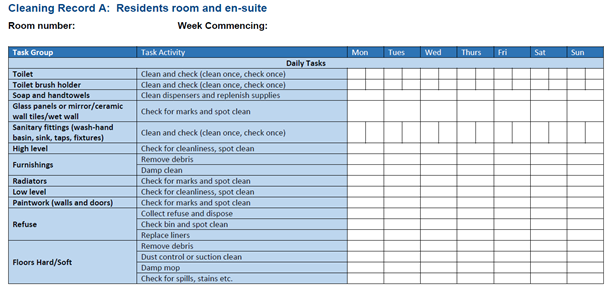
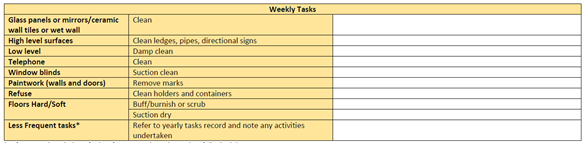
Standard operating procedures (SOPs) for all cleaning tasks.
Each SOP outlines the correct equipment, safety considerations, method, and outcomes required for each task. Table 3 shows the important steps that must be taken during the cleaning of floors.
Table 3: Example cleaning SOP: Floors
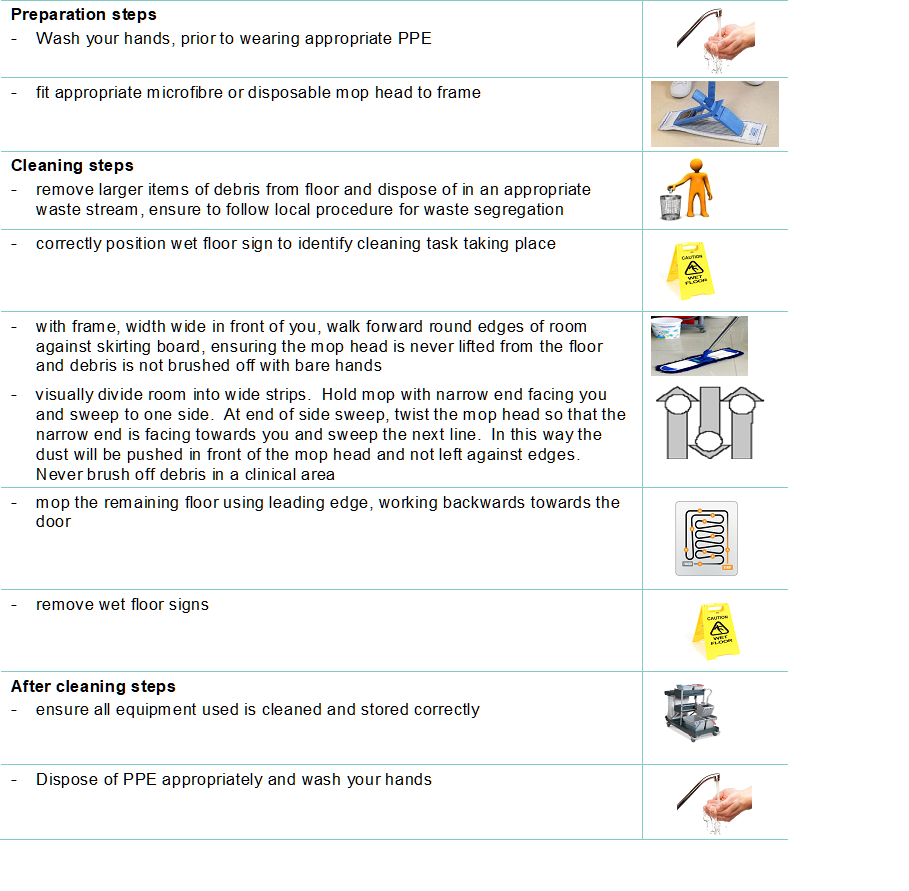
Process for checking
A process for checking the cleanliness of the care environment, to ensure standards are being maintained and to identify areas for improvement.
Decontamination of soft furnishings
Decontamination of soft furnishings may require to be discussed with the local HPT/ICT. If the soft furnishing is contaminated with blood or body fluids, it should be decontaminated immediately following manufacturer’s instructions by using detergent followed by a disinfectant solution or combination products. If the item is unable to be adequately decontaminated, then it should be discarded
Note: When an organisation adopts decontamination processes not recommended in the CH IPCM the care organisation is responsible for governance of and completion of local risk assessment(s) to ensure safe systems of work.
Read the Safe management of the care environment (Environmental Decontamination and Management of Blood and Body Fluid Spillages) literature review to find out more about why we do things this way for the care environment.
7 - Safe management of linen
Examples of linen you may have in the care home includes:
- bed linen (bed sheets, duvet, duvet covers, pillowcases)
- blankets
- curtains
- hoist slings
- towels
- resident clothing
There are three categories of linen:
Clean – Linen washed and ready for use
Used – All used linen in the care setting not contaminated by blood or body fluids
Infectious – All linen used by a person known or suspected to be infectious and/or linen that is contaminated with blood or body fluids for example faeces
Used or infectious linen may also be categorised as heat-labile: usually personal clothing where the clothing may be damaged (shrinking/stretching) by washing at a higher than recommended temperature than the label advises and therefore, cannot be subject to thermal disinfection. If such linen needs to be washed at a higher temperature for example if soiled or resident has a known infection they or their relatives need to be advised that the clothing may be damaged.
All clean, used and infectious linen should be handled with care and attention paid to the potential spread of infection. Appropriate temperatures for processing all used and infectious linen should be adhered to achieve thermal disinfection.
Clean linen
- Should be stored in a clean, allocated area. This should be an enclosed cupboard but a trolley could be used as long as it is completely covered with a waterproof covering that is able to withstand cleaning.
- Perform hand hygiene, in accordance with Section 2, prior to handling clean linen.
Used linen
Staff should:
- refer to SICPs PPE table for decision making regarding PPE use
- check that linen is free from inappropriate items before placing into the laundry receptacle, for example used equipment, service user personal belongings
- make sure that a laundry trolley or container is available as close as possible to the point of use for immediate linen deposit
Staff should not:
- rinse, shake or sort linen on removal from beds or trolleys
- place used linen on the floor or any other surfaces for example on a locker or tabletop
- re-handle used linen once bagged
- overfill laundry receptacles or trolleys
Infectious linen
Staff should:
- wear disposable gloves and apron before handling infectious linen
- put infectious linen directly into a water soluble laundry bag and secure before putting into a clear plastic bag and placing into a laundry receptacle/trolley
If using external laundry services both used and infectious linen bags/receptacles should follow local procedure and arrangements. Store all used/infectious linen in a designated, safe, lockable area whilst awaiting uplift.
All linen that is deemed unfit for re-use, for example torn or heavily contaminated, should be categorised at the point of use and disposed of in the appropriate local healthcare waste stream.
Washing residents personal linen
Appendix 1 National Guidance for Safe Management of Linen in NHSScotland Health and Care Environments - For laundry services/distribution contains information that is particularly relevant and may be useful for residential care settings where domestic-type (household) washing machines may be in place for laundering resident’s personal items and clothing.
Domestic-type washing machines are not typically programmed with the temperature settings required for thermal disinfection, therefore domestic-type machines may only be used for laundering personal items of clothing belonging to residents, such as those that are heat-labile.
Other types of used linen such as sheets should be reprocessed using a machine that is capable of a validated temperature disinfection stage.
If using a domestic type washing machine to launder resident’s personal items:
- wash items using the highest temperature you can and following the washing instructions
- use your normal washing powder or detergent and follow the instructions on the correct amount to use
- tumble-dry (if possible) following the washing instructions
- iron according to washing instructions. If possible, use a hot steam iron.
It is considered best practise to launder a resident’s personal items separately, that means not to mix items from multiple persons within a single load.
If visitors wish to take their relatives clothes home to be laundered, place laundry in an appropriate bag and provide them with a washing clothes at home leaflet.
If the residents clothing is very soiled or infectious, staff may recommend that the clothing is washed in the care home’s laundry service if available, otherwise, the item should be disposed of in the appropriate healthcare waste stream following discussion with the resident or their relative(s).
Read the safe management of linen literature review to find out more about why we do things this way when dealing with linen.
8 - Blood and body fluid spillages
Spillages of blood and other body fluids may transmit blood borne viruses.
Important words and what they meanA blood borne virus is a virus carried or transmitted by blood, for example Hepatitis B, Hepatitis C and HIV.Body fluids are fluids produced by the body such as urine, faeces, vomit or diarrhoea. These body fluids may also contain blood.
Blood and body fluid spillages should be decontaminated:
- as soon as is reasonably practical by staff trained to undertake this safely
- using body fluid spill kits/dedicated equipment
Dedicated products for this purpose should be prepared and used in accordance with the manufacturer’s instructions
Local policies should be available which define procedures and processes to follow for the decontamination of blood and body fluid spillages which is inclusive of type of product, spillage type, volume and surface material.
Suitable PPE should be worn based on the level of associated risk of exposure or contamination.
Any materials used for the decontamination of blood and body fluid spillages should be disposed of as infectious clinical waste.
 Use the poster management of blood and body fluids to help you when you clean up blood and body fluid spillages.
9 - Safe disposal of waste (including sharps)
Classification of waste
Waste regulations require the classification of waste based on hazardous characteristics.
- Special (hazardous) waste. Special waste includes a range of controlled wastes, defined by legislation, which contain dangerous or hazardous substances. Examples of special (hazardous) waste resulting from healthcare activities includes sharps, infectious or potentially infectious clinical waste and some pharmaceuticals or medicinal wastes.
- Non-hazardous waste is residual waste produced in both clinical and non-clinical settings which may include dry recyclates (glass, paper and plastics, metals, cardboard), food waste, packaging waste and furniture.
Segregation (separating) of waste
Waste bags in care homes should be colour coded to denote the different waste streams.
Different types of waste will be produced within care homes.
Some waste may be considered non-hazardous, for example paper hand towels, while other types of waste need special handling and disposal because of their hazardous properties for example, sharps and waste from service users who have or may have an infection.
SHTN 03-01 contains a full colour-coded waste segregation guide however, the most frequently used waste streams are summarised below.
- Black (non-hazardous)
- residual waste remaining after all source segregated recyclates have been removed.
- Orange (infectious)
- consists of infectious or potentially infectious substances or items.
- orange lidded leak resistant receptacles may be used for solidified infectious liquids.
- orange bags may be used for items such as PPE, spillage kits, swabs or dressings contaminated or likely to be contaminated with blood and/or body fluids including saliva.
- orange lidded sharps box used for sharps disposal only
Local risk assessed processes for waste disposal should be followed and guidance from local contractors may apply.
Safe management of waste
Care home staff should ensure:
- all waste is managed according to relevant legislation and any local risk assessed processes
- the appropriate PPE is used when handling any special (hazardous) waste
- waste is disposed of as close to the point of use as possible, and segregated using the correct colour-coded waste bag or container compliant with UN and relevant industry standards
- liquid waste is disposed of via the toilet or macerator, or where this is not possible, solidified and placed in an appropriate rigid leak resistant receptacle
- clearly marked and secure containers for sharps disposal are available where sharps are used
- schedules are in place for the cleaning, emptying and uplifting of waste bins and waste does not accumulate in corridors, rooms, care areas or other publicly accessible areas
- waste bags are never overfilled and have been appropriately sealed, labelled and marked with the date and location before being stored for uplift.
- waste bags are securely sealed using a closure technique such as a ‘swan neck’
- a ‘swan neck’ is a way of closing bag by tying in a loop and securing with a zip tie or tape to make a handle
- there is a dedicated area for the storage of waste that is secure and not accessible to residents or the public
- any PPE is removed, and hand hygiene is performed after handling waste
Read the safe disposal of waste literature review to find out more about why we do things this way when dealing with waste.
10. Occupational Safety: Prevention and Exposure Management (including sharps)
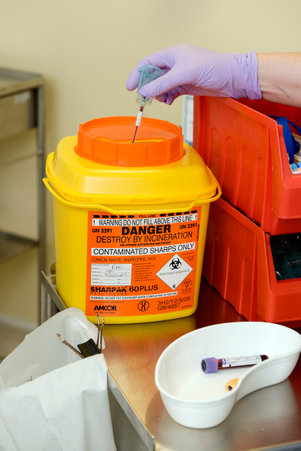 All care homes should have policies in place to ensure that staff are protected from occupational exposure to microorganisms (germs), particularly those that may be found in blood and body fluids.
Important words and what they meanOccupational exposure is exposure of staff to blood or body fluids in the course of their work.A sharp is a device or instrument such as needles, lancets and scalpels which are necessary for the exercise of specific healthcare activities and are able to cut, prick and/or have the potential to cause injury.Safety device or safer sharp is a medical sharps device which has been designed to incorporate a feature or mechanism that minimises and/or prevents the risk of accidental injury. Other terms include (but are not limited to) safety devices, safety-engineered devices and safer needle devices.
The Health and Safety (Sharp Instruments in Healthcare) Regulations (2013) outline the regulatory requirements for employers and contractors in the healthcare sector in relation to:
- arrangements for the safe use and disposal of sharps
- provision of information and training to employees
- investigations and actions required in response to work related sharps injuries
Safe management of sharps in the care home
Sharps handling must be assessed, kept to a minimum and eliminated if possible with the use of approved safety devices.
Sharps safety
- Always dispose of needles and syringes as a single unit immediately at the point of use.
- Always assemble and label sharps containers correctly as per manufacturers instructions.
- Always use the temporary closure mechanisms on sharps containers in between use.
- Always follow manufacturers’ instructions for safe use and disposal.
- Never re-sheath used needles or lancets.
- Never store sharps containers on the floor.
- Never allow access of sharps containers to residents or the public (unless there is a documented risk assessment which allows for any independent /safe handling of sharps)
- Never fill sharps containers more than three-quarters full.
Significant occupational exposure
A significant occupational exposure is when someone is injured at work from using sharps or exposed to risk from blood or body fluids which may then result in a blood borne virus (BBV) or other infection.
Examples of this would be:
- a percutaneous injury for example injuries from needles, instruments, bone fragments, or bites which break the skin
- exposure of broken skin for example abrasions, cuts, eczema
- exposure of mucous membranes including the eye from splashing and/or spraying of blood or bodily fluids
If you think or know you have had a significant occupational exposure you should:
- report this immediately to the designated person in your care home, this is a legal requirement
- follow the local agreed process for management of an occupational exposure incident and follow the management of occupational injuries flow chart
Resources
Read the management of occupational exposure to Blood Borne Viruses (BBVs) literature review to find out more about why we do things this way for occupational exposure.
The management of occupational exposure incidents flowchart should be used within your care home so you know what to do for an occupational exposure.
Chapter 2 : Transmission based precautions (TBPs)
SICPs may be insufficient to prevent cross-transmission of specific infectious agents. Therefore, additional precautions known as transmission based precautions (TBPs) are required to be used by staff when caring for residents with a known or suspected infection or colonisation.
The way in which we describe transmission routes has changed. You can find out more about this in our ‘What’s changed?’ guide. Our Frequently Asked Questions (FAQs) resource provides answers to some of the common queries associated with the changes.
Transmission routes
Transmission routes are the ways in which an infectious agent spreads from one place or person to another. Some infectious agents can be transmitted by more than one route.
Contact transmission route
Transmission of infectious agents from one person to another by direct physical contact (direct contact transmission) or indirectly through contact with a contaminated object or surface (indirect contact transmission).
Air transmission route
Transmission of infectious agents from one person to another (without touching) via body fluids that travel from the infected person through the air. Air-transmitted infectious agents can be transmitted by splashing or spraying of body fluid particles onto the mucosa and/ or by inhaling body fluid aerosols.
Application of TBPs
Application of TBPs may differ depending on several factors. Clinical judgement and decisions should be made by staff on the necessary precautions. This should be based on the:
- suspected or confirmed infectious agent
- transmission route of the infectious agent
- care setting and procedures undertaken
- severity of the illness caused
Respiratory infections
Respiratory infectious agents are mainly transmitted via the air transmission route. To support the application of TBPs, respiratory infectious agents have been categorised into three groups: Respiratory 1 (R1), Respiratory 2 (R2) and Respiratory 3 (R3).
These categories take into account:
- severity of illness associated with infection
- transmissibility
- associated availability of vaccination and treatments (prophylaxis)
Within care homes, respiratory infections are likely to fall within the R1 category which includes Rhinovirus (common cold), Influenzas A and B (flu), SARS-CoV2 (COVID-19) and Respiratory Syncytial Virus (RSV).
Appendix 11 provides details of infectious agents, associated presentation or disease, he type of precautions, optimal patient placement, isolation requirements and respiratory (‘R’) category (for respiratory infectious agents).
If you want to understand more about how each pathogen is categorised, this is described in the NIPCM glossary under 'respiratory categories'.
Further information on transmission based precautions can be found in the definitions of Transmission Based Precautions literature review.
1. Resident placement/assessment for infection transmission risk
The potential for transmission of infection must be risk assessed prior to a resident’s arrival to the care home or before transferring to another care provider and should be continuously reviewed throughout their stay. A respiratory symptom screening questions checklist is also advised to be used, and this can be found within the resources section of the NIPCM.
A risk assessment will influence TBP decisions, and residents who may present a transmission risk include (but are not limited to) those:
- with symptoms such as loose stools or diarrhoea, vomiting, fever or respiratory symptoms.
- with a known (laboratory confirmed) or suspected infectious pathogen for which appropriate duration of precautions as outlined in A-Z of pathogens are not yet complete
- known or suspected to have been previously positive with a Multi-drug-Resistant Organism (MDRO), for example MRSA, *CPE
- who have been admitted to a hospital outside Scotland in the last 12 months (including those who received dialysis)
This is not an exhaustive list, and risks need to be assessed for each resident.
*CPE should be considered if the resident meets any of the following criteria within the 12-month period before admission:
- was an inpatient in a hospital outside of Scotland
- received holiday dialysis outside of Scotland
- was a close contact of a person who has been colonised or infected with CPE.
A CPE toolkit for non-acute settings for further information and requirements.
Staff should do the following if any resident displays signs and/or symptoms of infection:
- obtain advice on the resident’s clinical management from their GP and advice on appropriate IPC management from the local NHS Board IPCT or HPT
- make resident placement decisions based on advice received or sound judgement by trained clinical staff who are involved in the resident’s management
- if transport to another care provider is required, advise the transport staff of the resident’s infectious condition. Residents should not be moved within the care home if they have signs and symptoms of infection unless essential.
Residents who are known or suspected to be infectious may require to be isolated temporarily within their own rooms, during the period of infectivity A to Z of pathogens. Isolation decisions and assessment of infection risk (including isolation requirements) must be clearly documented in the resident notes.
Essential visits should be enabled and an explanation provided to the visitor of potential infection risks, and PPE offered. When undertaking a risk assessment, staff must also consider Anne's law and in particular:
- resident and essential care supporters’ involvement in any IPC related precautions
- resident ability to comply with isolation and any potential impact of same
When residents who are required to isolate in their own room because of a known or suspected infection, it is important that:
- residents remain in their rooms whilst considered infectious and the door should remain closed. If it is not possible for safety reasons then an individual risk assessment should be carried out, and any decisions or actions should be documented. The local NHS Board IPCT or HPT may be contacted for advice
- suitable discrete signage is placed on the resident's room door advising visitors not to enter the room until they have spoken to a member of staff
- there should be as much consistency in staff allocation as possible to care for residents in isolation room areas as an additional IPC measure. This is known as ‘staff cohorting’
- resident isolation requirements should remain under continuous review considering individual risk factors and the impact on the resident. The local NHS Board IPCT or HPT may be contacted for advice in these circumstances
- infectious residents should only be transferred to other care providers if medically necessary. If the resident has an infectious agent transmitted by the air route then, if possible or tolerated, the resident should wear a fluid resistant surgical face mask during transfer. Receiving care providers and transport staff must be made aware of the necessary precautions
Note: If a resident requires isolation because of infection or in an outbreak situation, this should be individually risk assessed and documented to ensure the safety and health and wellbeing needs of the resident. Isolation must be for the minimum period specified and the resident must be monitored daily.
Residual respiratory exposure risk
If a resident vacating a room has a suspected or confirmed respiratory infection, the room may need to be left vacant for a period to ensure that any remaining potentially infectious particles are adequately cleared from the air to minimise the exposure risk to the next occupant. The clinical team should assess:
- the stage of infection, and whether the vacating resident continues to pose a transmission risk.
- the severity classification of the infection (R1, R2, or R3), and the vulnerability of the incoming resident
If entering the room during the vacancy period, health and care workers should wear appropriate PPE: a surgical mask or RPE should be used in line with the respiratory category associated with the vacating resident. Refer Appendix 15 for the mask selection algorithm. This would include when undertaking cleaning post discharge.
See Hierarchy of Controls (engineering controls) for information on the impact of ventilation on clearance times.
Ensure a minimum of 10 minutes has passed to allow the largest particles to settle on surfaces before terminal decontamination – see terminal decontamination for additional information.
For more information read the placement, isolation and cohorting literature review.
2. Safe management of non-invasive, reusable, shared care equipment in a resident isolation room
Cleaning and decontamination of care equipment is essential to reduce the spread of infection when infection therefore:
- use single-use items where possible
- non-invasive, reusable, care equipment should be dedicated to the isolation room and decontaminated prior to use on another resident see Section 1.5. Safe Management of Care Equipment
- an increased frequency of decontamination should be considered for non-invasive, reusable, care equipment when used in resident isolation rooms
- detergent, disinfectant or combination products should be prepared and used according to manufacturer instructions including chemical concentration, application style and contact time, whilst taking into account the specific equipment manufacturers instructions.
A flowchart describing the decontamination of non-invasive care equipment is available Appendix 7.
Read the Safe management of non-invasive, reusable shared care equipment literature review.
3 - Safe management of the care environment
Resident Isolation room
Isolation rooms should be decontaminated at least daily; this may be further increased on the advice of the local NHS Board IPCT or HPT.
Isolation rooms should be decontaminated using either:
- A detergent followed by a disinfectant solution
or
- A combination product
Manufacturer’s instructions should always be followed regarding preparation and use of a detergent, disinfectant or combination products.
Increased frequency of decontamination/cleaning schedules should be incorporated into the environmental decontamination schedules for areas where there may be higher environmental contamination rates, for example:
- toilets and commodes particularly if residents have diarrhoea
- “frequently touched” surfaces such as door and toilet handles, light switches, chairs, over bed tables and bed rails.
Do not refill spray containers for cleaning products as there is a risk of contamination.
Terminal decontamination of an isolation room
Resident isolation rooms must be terminally decontaminated following resolution of symptoms, discharge or transfer. This includes removal and laundering of all curtains and bed screens.
Remove from the vacated isolation room all:
- healthcare waste and any other disposable items (bagged before removal from the room)
- bedding, bed screens and curtains and manage as infectious linen (bagged before removal from the room)
- non-invasive, reusable, care equipment should be decontaminated prior to removal from the room
The room should then be disinfected using either:
- A detergent followed by a disinfectant solution
or
- A combination product
Manufacturer’s instructions should always be followed regarding preparation and use of detergent, disinfectant or combination products.
Note: The room should be cleaned from the highest to lowest point and from the least to most contaminated point.
To allow any larger particles to settle onto surfaces, wait a minimum of 10 minutes prior to undertaking any terminal decontamination process at the point the room has been vacated by a resident who still has a suspected or confirmed respiratory infection.
4. Personal Protective Equipment (PPE)
PPE is also required during the application of TBPs when undertaking care tasks, or entering a resident’s room who has a suspected or known infection.
All PPE must be:
- located close to the point of use
- stored in a clean and dry area to prevent contamination until needed for use
- within manufacturer’s expiry dates
- single-use only items unless specified as reusable by the manufacturer
- checked for any damage or defects before donning
- changed immediately after individual use and/or following completion of a procedure or task
- disposed of after use into the correct waste stream
- not be worn inappropriately outside of care delivery for example, moving around corridors.
Gloves
Gloves are a single-use item and should be donned immediately prior to any exposure risks and doffed immediately after each use or upon completion of a task.
Gloves should:
- be worn when exposure to blood, body fluids, (including but not limited to secretions and/or excretions), non-intact skin, lesions and/or vesicles, mucous membranes, hazardous drugs, and chemicals for example cleaning agents, is anticipated/likely
- never be worn inappropriately in situations such as to go between residents, move around a care area, work at IT workstations
- be changed if a perforation or puncture is suspected or identified
- be appropriate for use, fit for purpose and well-fitting
- never be decontaminated with hand rub
Resources
For appropriate glove use and selection see the glove selection chart provided in Appendix 5.
Further information can be found in the Gloves literature review.
Aprons/gowns
An apron should be worn:
- when providing direct care for the individual resident
- when undertaking tasks within the resident’s room
A fluid repellent gown may be used when more coverage is required, for example if the resident has scabies.
Further information can be found in the Aprons/Gowns literature review.
Eye and face protection
Eye and face protection should be used:
- whenever there is an anticipated risk of splashing or spraying from any blood or bodily fluids
- in combination with the appropriate mask, when providing care for a resident who has a suspected or confirmed respiratory infection
Types of eye or face protection suitable for use include goggles, face shields or visors, and surgical face masks with integrated face shields.
Note: When used in combination with an FFP3 respirator (see RPE), the mask and eye/face protection require to be compatible, so that the eye/ face protection does not interfere with the seal of the respirator.
Note: Prescription eyeglasses and contact lenses should not be considered a form of eye or face protection.
You can find out more information about infectious agents and precautions required in Appendix 11.
Fluid resistant surgical face masks (FRSM)
Fluid-resistant surgical masks should be worn:
- when a resident has symptoms suggestive of a transmissible respiratory infection (including on admission or transfer) and the infectious agent has not yet been determined
- upon entry to, and for the duration they are within, areas containing residents who are suspected or confirmed to have an R1 respiratory infection
- individuals may choose to wear RPE instead of a type IIR fluid resistant surgical face mask, based on personal choice – see Appendix 15 for the mask selection algorithm.
- by residents suspected or confirmed to have a transmissible respiratory infection whilst out with their own room, and if they are being moved or transported elsewhere. A risk assessment should always be by clinical staff as to whether the mask can be tolerated by the resident, and if it would compromise their care, capacity or wellbeing
- worn by health and care staff, residents (where tolerated and does not compromise care) and visitors during epidemics or periods of increasing or high rates of local transmission of respiratory infection within the care home. Local health boards may undertake a risk assessment and advise extended use of FRSMs as part of a suite of control measures. Local epidemiology should be used to inform the risk assessment
Transparent face masks may be considered for use when there are communication barriers, however they must meet the specifications of BS EN 14683:2025.
Read Appendix 11 for details of the type of precautions, optimal resident placement, isolation requirements and any respiratory precautions required.
Respiratory Protective Equipment (RPE)
The use of FFP3s is governed by health and safety regulations. It is the responsibility of the Care Home Provider to ensure that staff have been fit tested for the use of FFP3, if their role may require use, to ensure the required protection is provided.
The Health and Safety Executive (HSE) provides information regarding fitting and fit checking of RPE.
Respiratory protective equipment (RPE) should be worn when caring for a resident who has a suspected or confirmed R2 or R3 respiratory infection.
When caring for a resident with a suspected R1 respiratory infection, RPE may be worn by individuals who have been advised to do so by occupational health, their GP, or medical practitioner.
Individuals may choose to wear RPE where FRSM is indicated for use when caring for a resident with a suspected or confirmed R1 respiratory infection, based on personal choice. Refer to the mask algorithm.
Note: As RPE filters incoming air to the wearer and not the air that is expelled by the wearer, they should not be used by anyone suspected or confirmed to be infectious.
There are 2 main types of respirators used within health and care settings in Scotland. These are:
- tight-fitting respirators (FFP3) that require face-fit testing and fit-checking on each use
- loose fitting respirators (often referred to as powered hoods, powered respirators or PAPR)
Respirators with unshrouded valves are not considered to be fluid resistant. Where there is a risk of contamination with blood or body fluids additional PPE should be worn, such as full-face shield/visor.
Other elements of PPE should still be used in accordance with SICPs when using Respiratory Protective Equipment. See Chapter 1.4 for PPE use for SICPs.
Filtering Face Piece 3 (FFP3) Respirators
RPE should be changed after each use. Other indications that a change is required include:
- if breathing becomes difficult
- if the respirator becomes wet or moist
- if the respirator is damaged or contaminated
FFP3 respirators with unshrouded valves are not considered to be fluid resistant. Where there is a risk of splash contamination for the wearer with blood or body fluids additional PPE should be worn, such as a full face shield/visor.
Valved FFP3 respirators should not be worn when a sterile field is required. An MHRA safety alert can be viewed.
FFP3 respirators should be compatible with other facial protection used, for instance eye protection, so that this does not interfere with the seal of the respiratory protection.
The wearer should be clean shaven and free of any jewellery or piercings to support effective fit testing by ensuring a smooth surface area for a seal. The Facial Hairstyles and Filtering Facepiece Respirators poster gives further information on compatibility of facial hair and FFP3 respirators and can be used when fit testing and fit checking.
Fit Testing
All tight-fitting RPE (for instance FFP3 respirators) must be fit tested to an individuals face prior to use.
Face fit testing should be:
- conducted by a competent fit tester as outlined by British and International Standards BS ISO 16975-3: 2017
- recorded for each individual, including mask brand, style, model and size
- repeated if changing brand, style, model and size
- repeated following reported or observed changes to the wearer’s face that could impair the seal (for example, due to weight loss or gain, dental or cosmetic work)
Fit checking
A fit check should be performed each time tight fitting RPE is donned, to ensure a tight seal has been achieved. A fit check is not a substitute for fit testing.
If a fit test or check fails, then the RPE should be adjusted and fit test/check repeated. If a tight seal cannot be achieved, then other types of RPE that offer equivalent protection may be considered.
Individuals should not undertake tasks where RPE is required if a fit test or check has failed and alternative RPE is unavailable.
Donning (putting on)
- Donning (putting on) RPE should be done in line with manufacturer’s instructions. RPE should be checked for any damage or defects before donning.
- Hand hygiene should be performed before donning RPE and, once on, the front of the RPE should not be touched.
- A fit check should be performed once donned to ensure a tight seal has been achieved.
- RPE should be donned outside of the resident’s room or designated care area.
Doffing (removing)
- RPE must be removed after exiting the resident’s room
- Where worn with other items of PPE, RPE must be removed last.
- RPE should be removed using only the straps to minimise contact with the outside surface.
- Hand hygiene should be performed before and after removal of RPE.
See Appendix 6 for donning and doffing advice.
RPE should be changed after each use. Other indications that a change in respirator is required include:
- if breathing becomes difficult
- if the respirator becomes wet or moist
- if the respirator becomes damaged or is obviously contaminated
A poster containing information on compatibility of facial hair and FFP3 respirators can be used when fit testing and fit checking.
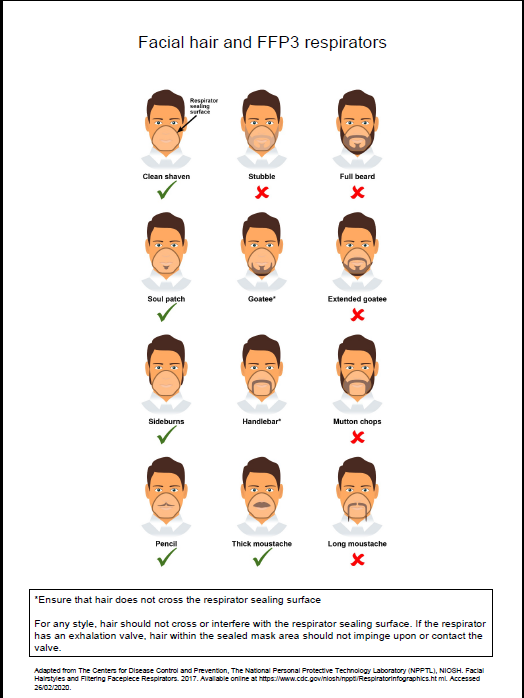
Further information regarding fitting and fit checking of respirators can be found from the Health and Safety Executive
Powered respirator hoods
Powered respirator hoods are an alternative to FFP3 respirators for example when fit testing cannot be undertaken or achieved.
Where feasible, reusable components (for example, powered hoods and helmets) should be issued for individual use.
Powered hoods:
- must be configured according to manufacturer’s instructions
- must be single use (disposable) and fluid resistant
- filter must be enclosed with the exterior and the belt able to withstand disinfection
Donning
- RPE should be checked for any damage or defects before donning.
- Hand hygiene should be performed before donning a powered respirator and, once on, the exterior should not be touched.
- A powered respirator should be donned outside of the patient’s room or care area, or within an ante room.
Doffing
- Powered respirators must be removed after exiting the care area or room.
- Where worn with other items of PPE, a powered respirator must be removed last.
- Hand hygiene should be performed before and after removal of the powered respirator.
PPE should always be used in line with SICPs and as below as part of TBPs.
TBP PPE summary table
| Gloves | Aprons | Gowns | Eye/Face protection | Fluid Resistant Surgical Masks (FRSM) | Respiratory Protective Equipment (RPE) |
|---|---|---|---|---|---|
| As per SICPs. | When in contact with a residents environment or when providing direct care to those with suspected or confirmed infection or colonisation with a transmissible infectious agent. | When excessive splashing or spraying is anticipated. | When there is an anticipated risk of splashing and/or spraying of blood or bodily fluids. When caring for a resident with a suspected or confirmed respiratory infection in combination with the appropriate mask. |
When caring for a resident with suspected or confirmed respiratory infection and the infectious agent has not yet been determined. When caring for a resident with suspected or confirmed R1 respiratory infection. |
Worn when caring for a resident with a suspected or confirmed R2 or R3 respiratory infection. Worn following a personal assessment (medical or choice) – see mask selection algorithm. |
PPE for visitors
Visitors do not routinely require PPE unless they are providing direct care to the resident they are visiting.
However, if visiting a resident with a suspected or confirmed respiratory infection, visitors may be offered a fluid-resistant surgical mask to wear for the duration of the visit. Consideration should be given to providing visitors with RPE when visiting a patient with a suspected or confirmed infection caused by a category R2 or R3 respiratory infectious agent.
If the need for PPE is identified, staff should provide advice on its correct use. This must include fit testing for FFP3 (if required), advice on fit testing and appropriate donning and doffing for all PPE.
If, following an explanation of potential risks, a visitor declines to wear PPE when it is offered, then this should be respected, and the visit should not be refused. PPE use by visitors cannot be enforced and there is no expectation that staff monitor PPE use amongst visitors.
PPE use for care home visitors
| Gloves | Apron | Surgical Face Mask (type IIR) | RPE | Eye or Face Protection |
|---|---|---|---|---|
| If providing or participating in direct care activities which may expose the visitor to blood and/or body fluids, for instance assisted toileting or feeding. | If providing or participating in direct care activities which may expose the visitor to blood and/or body fluids, or which results in direct contact | Where splash or spray to nose or mouth is anticipated AND for the duration of a visit to a resident with suspected or confirmed respiratory infection. During essential visiting arrangements when the visitor has a suspected or confirmed transmissible respiratory infection. |
When visiting a resident who has a suspected or confirmed R2, R3 respiratory infection. | Where splash or spray to the visitor’s nose or mouth is anticipated, in addition to a face mask. |
5. Infection prevention and control during care of a deceased resident
The principles of SICPs and TBPs continue to apply whilst deceased residents remain in the care environment. This is due to the ongoing risk of infectious transmission via the contact route.
It is important that information on the infection status of the deceased is sought and communicated at each stage of handling and risk assessments performed.
Viewing, washing and/or dressing of the deceased resident
Appendix 12 - Application of infection prevention precautions in the deceased contains guidance on the precautions required and what is permitted for certain types of infections.
Staff should advise relatives of the appropriate precautions to be taken when viewing and/or having physical contact with the deceased resident.
Read the infection prevention and control during care of the deceased literature review for more information about dealing with the deceased.
Care home appendices
These appendices from the NIPCM can be used in care homes.
Appendix 5 - Glove use and selection
Appendix 6 - Putting on and removing PPE
Appendix 7 - Decontamination of reusable non-invasive care equipment
Appendix 8 - Management of linen at care level
Appendix 9 - Management of blood and body fluid spillages
Appendix 10 - Management of occupational exposure incidents
Appendix 12 - Application of infection control precautions in the deceased
Appendix 15 - Mask selection algorithm
Appendix 16 - Hierarchy of controls
Care home resources
The resources section can be used as supporting tools for the Care Home Infection Prevention and Control Manual (CH IPCM).
- Care Home Infection Prevention and Control (IPC) Standards Checklist
- Care Home Infection Prevention and Control Compendium (v7.1, July 2026)
- Catheter Associated Urinary Tract Infection (CAUTI)
- HAI Compendium
- Hand hygiene
- Gastro-intestinal illness
- Care Home IPC Webinar: Infection Prevention & Control Interactive Education Kits. October 2025
- Information leaflets.
These leaflets are also available in different languages National Infection Prevention and Control Manual: Information Leaflets - language translations (scot.nhs.uk)- Clostridiodes difficile (CDI) - Information for people who are getting care, their visitors, and anyone else who is in a care setting
- Group A Streptoccocal infection - information for patients
- Healthcare associated infection (HAI) - Information for the public
- Vancomycin-resistant enterococci VRE - Information for patients
- Washing clothes at home - Information for people in hospitals or care homes and their relatives
- Norovirus - key steps to help stop the spread of infection poster
- Respiratory hygiene
- Scabies: Back to Basics Presentation - 23 October 2024
- Transmission Based Precautions
- Transmission Based Precautions Waste Management: Back-to-Basics webinar - 12 December 2024
- Transmission based precautions posters (editable)
- Transmission based precautions - What's changed powerpoint
- Winter preparedness campaign 2026
Content
- What is the Care Home Infection Prevention and Control (CHIPC) Manual?
- Responsibilities for the CH IPCM
- Chain of infection
- Chapter 1: Standard Infection Control Precautions (SICPs)
- 1 - Resident placement: assessment for infection risk
- 2 - Hand hygiene
- 3 - Respiratory and cough hygiene
- 4 - Personal Protective Equipment (PPE)
- 5 - Safe management of non-invasive, reusable, shared care equipment
- 6 - Safe management of the care environment
- 7 - Safe management of linen
- 8 - Blood and body fluid spillages
- 9 - Safe disposal of waste (including sharps)
- 10 - Occupational Safety: Prevention and Exposure Management (including sharps)
- Chapter 2: Transmission Based Precautions (TBPs)
- 1. - Resident placement/assessment for infection transmission risk
- 2 - Safe management of non-invasive, reusable, shared care equipment in a resident isolation room
- 3 - Safe management of the care environment
- 4 - Personal Protective Equipment (PPE) (TBP)
- 5 - Infection prevention and control during care of a deceased resident
- Care home appendices
- Care home resources
- Contact us